There are two ways to get senior portrait outfits wrong, and almost everyone picks one of them.
The first is overthinking. You scroll for three weeks, buy something you have never worn, and show up in a stiff dress that makes you stand like you are waiting to be called in at the dentist. The second is under-thinking. You grab five things off the closet floor, and every one of them turns out to be a dark top with jeans. Five different shirts. One photograph, repeated.
Neither of those is a taste problem. It is an information problem. Clothes behave differently in front of a camera than they do in a mirror, and nobody ever explains the difference. So here it is — the actual rules, with the reasons attached, because the reasons are what let you make good calls on your own.
The rule everything else comes from
Your clothes should lose.
The best senior portrait outfit is the one nobody describes afterward. They describe you.
Every decision below is downstream of that. Color, texture, fit, shoes — all of it is in service of keeping the eye on your face and your posture instead of on a graphic, a logo, or a hemline you keep tugging at. An outfit that pulls attention is not a better outfit. It is competition.
Color: what actually happens in Virginia green
Around Danville, a lot of sessions happen against green. Pine forest, farm edges, the Riverwalk in June. Here is the part no one tells you: green is not a background. It is a light source.
Sunlight passes through and bounces off leaves, and it comes back green. That light lands on your shirt and on the underside of your jaw. It is fixable in editing, but the cleaner move is not to fight it in the first place.
What holds up against Virginia foliage:
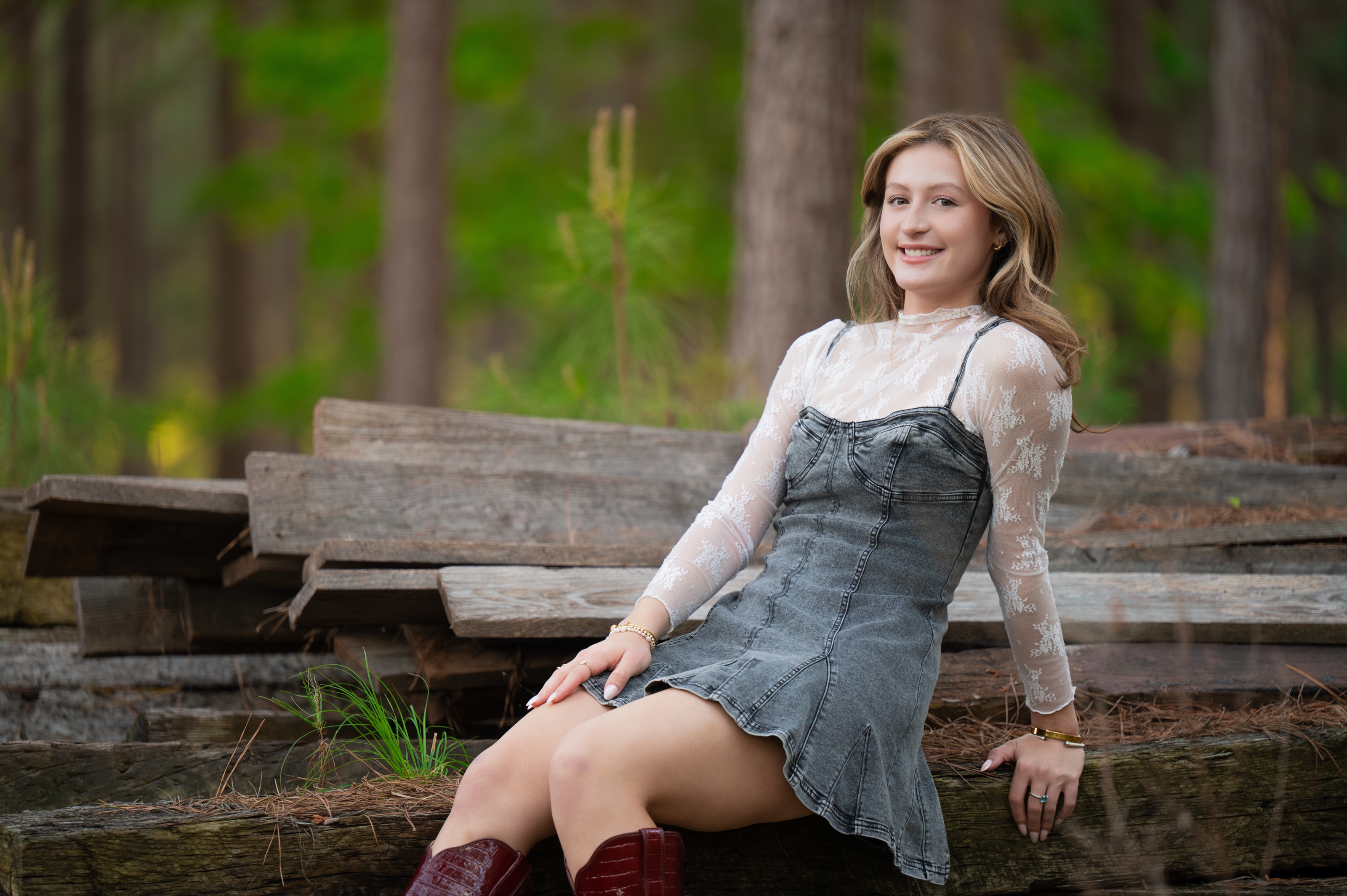
- Warm and earthy. Cream, oatmeal, camel, rust, terracotta, mustard, olive, and denim in any wash. These sit in the opposite family from green, so you separate from the background instead of blending into it.
- Deep jewel tones. Burgundy, navy, plum, teal, deep emerald. Rich enough to read as color, dark enough not to throw a cast onto your skin.
- Soft neutrals. Ivory, bone, dusty blue, soft blush. These photograph beautifully and stay quiet.
What fights you:
- Neon and anything highlighter-adjacent. Saturated bright colors reflect themselves onto your neck and chin. A neon top gives you a green or orange jaw, and correcting it means pulling color out of your skin too.
- Kelly green and lime in a forest. You disappear.
- Bright white as a first choice. White is not wrong, it is just the brightest object in the frame, and the eye goes to bright before it goes to anything else. Ivory or bone does the same job without shouting.
Black deserves its own note. Black is sleek and it photographs well in direct, shaped light — a black jacket downtown at golden hour against warehouse brick is excellent. In deep open shade, black stops being a garment and becomes a silhouette with no detail in it. Wear black, just do not wear it for all three outfits.
Location matters more than most guides admit. The warehouse district brick is warm orange-red, so bright red and orange get lost against it while cream, denim, black, and deep green all pop. Downtown murals are already loud, so wear something quiet and let the wall do the talking. Farms and pine want earth tones and denim.
Texture beats pattern, every time
A camera records two things exceptionally well: the shape of light, and the texture of a surface. Pattern is a third thing, and it competes.
Ribbed knit, cable knit, corduroy, linen, waffle, suede, raw denim, leather, chunky weave — all of these catch light unevenly, which gives an image depth without asking for attention. A cream ribbed sweater is more interesting on camera than a printed blouse, and it will still look right in five years.
If you want pattern, go big and low-contrast. A wide stripe, a loose floral on a soft ground, a large plaid. What fails is small and busy: pinstripes, tight houndstooth, micro-check, tiny geometrics. Beyond looking chaotic at a distance, a tight repeating pattern can interfere with the sensor's own grid and produce a shimmering wavy distortion across the fabric. It is called moiré, and it is genuinely difficult to remove.
One more: watch high-sheen fabrics. Satin and anything shiny can blow out into a bright patch in full sun. In softer light it is gorgeous. If you are bringing something with real sheen, bring it as one of your looks rather than your only one.
Fit is the whole thing
Fit outranks brand, price, and whatever is trending. It is the single biggest difference between a photo that looks styled and one that looks borrowed.
Too tight and you lose poses. If you cannot sit on the ground, cross your legs, or raise your arms, a whole category of images stops existing. Too loose and fabric adds volume the camera flattens into shapelessness. Sleeves that end at the widest part of your arm will make it look wider — a quarter inch of length either direction changes it.
The test takes ninety seconds. Put it on. Sit on the floor. Cross your legs. Raise both arms. Walk across the room. If you adjusted anything, you will be adjusting it all session.
Then: empty your pockets. Phones, keys, and wallets show up as hard square lumps in every full-length frame, and there is no fixing it after the fact. And hang your clothes rather than folding them into a bag. Crease lines from a backseat pile are visible in every shot.
Layers do more work than an extra outfit
A denim jacket, a flannel, a cardigan, a blazer — put it on for half the frames and take it off for the rest, and one outfit reads as two. It costs nothing, takes no changing time, and it is the most efficient variety you can bring. It also solves the Danville shoulder-season problem where the morning is 48 degrees and the afternoon is 70.
How many outfits, and how to keep them from being the same outfit
Three is the number. Three that are actually different.
Here is the test: lay them out and ask whether a stranger could describe the difference between them in one sentence each. If two of them come out as "dark top and jeans," swap one.
- The one that looks like you on a good day. Casual, true, comfortable. This is where you look most like yourself, and it is usually the one your friends love.
- The elevated one. A dress, a blazer, something with structure. This is the one that ends up framed on a wall and sent to grandparents.
- The one with a point of view. A texture, a strong color, a jacket, something with a little attitude. This is the one that keeps the gallery from being polite.
If there is a fourth thing that matters — a jersey, an instrument, boots you have worn out, a letterman — bring it. It does not need a full outfit built around it.
Every change costs time, and time spent changing is time not spent being photographed. Bring three you love rather than five you feel neutral about.
Shoes
People forget shoes and then discover they are in half the frames — every full-length, every seated pose, every walking shot.
- Bring the shoes that belong with each outfit, not one pair meant to survive all three.
- Beat-up white sneakers photograph as beat-up white sneakers. Clean them or bring something else.
- Heels sink into a farm field and into the soft shoulder along the Riverwalk. Save them for downtown pavement and bring boots for the grass.
- Boots, clean leather sneakers, and simple flats do the most work across the most locations.
Jewelry, and everything else you are wearing without thinking
Simple, real, and yours. Small hoops, a chain you actually wear, a watch that means something. Jewelry should read as a detail, not as an event. Very large earrings tangle in loose hair and half-vanish anyway.
Then the things nobody plans for. Take the hair tie off your wrist — nearly every senior is wearing one, it appears in every single frame, and it is the first thing people notice at the reveal. Take a smartwatch off well before the session so the tan line has time to fade. Check your nails, because hands end up near faces and chipped polish shows. If you wear glasses every day, wear them; reflections are manageable and you should look like yourself. If you got them last week, decide before the session rather than during it.
The avoid list, with the reason attached
- Logos and graphics. A brand mark competes with your face and it stamps a date on the image. A photo of you at eighteen should still look like you at forty, not like a specific season of a specific year.
- Neon. It reflects onto your skin. Covered above, worth repeating.
- Tiny busy patterns. Moiré and visual noise.
- Brand-new clothes you have never worn. They are stiff, they hold the fold creases from the package, and you do not yet know how you move in them. Wear it once and wash it once before the session.
- Something a parent chose that the senior hates. This one is not about fabric. A camera picks up reluctance faster than it picks up anything else.
A short section for parents
You are paying for this, so you get a vote. The places your vote helps most: fit, condition, and the one dressier outfit. That is the frame that ends up on your wall, and it is reasonable to have an opinion about it.
The place to hold back is personality. If your senior wants the leather jacket, the boots, and the darker lip, that is the photograph you will be most grateful for in ten years, because it is a record of who they actually were at eighteen rather than who looked tidiest that afternoon.
Where parents are genuinely most useful is logistics. Clothes clean, steamed, and on hangers. Shoes matched to outfits. A small bag with a brush, safety pins, a lint roller, blotting sheets, and water. If a haircut is happening, schedule it around two weeks out so it has time to settle rather than the day before.
You do not have to figure this out alone
Once a session is booked, you get a styling guide, and we work through outfits together — what to bring, what to leave home, and what will hold up in the specific light of the specific place we are shooting. Sessions are fully guided from there. Posing, direction, energy, a playlist. You never need to know what to do with your hands, because that is my job, and I pursued modeling myself specifically to understand how it feels on that side of the lens.
Portrait Experiences begin at $500 and include five social-sharing digital images of your choice, plus a private in-person reveal where we go through the images together and decide what deserves to be printed. Everything is hand-edited and true to color, with no presets and no batch filters. You will see a sneak peek within a week and the full gallery in two to three weeks. If the weather turns, rescheduling is free.
Bring three outfits you like. I will help you get there.
Written by Patrick Gibson
Wedding, portrait and branding photographer based in Danville, Virginia — serving Lynchburg, Martinsville, South Boston, Greensboro and Raleigh.